Biologically Realistic Modeling of the Drosophila Motion Detection Pathway
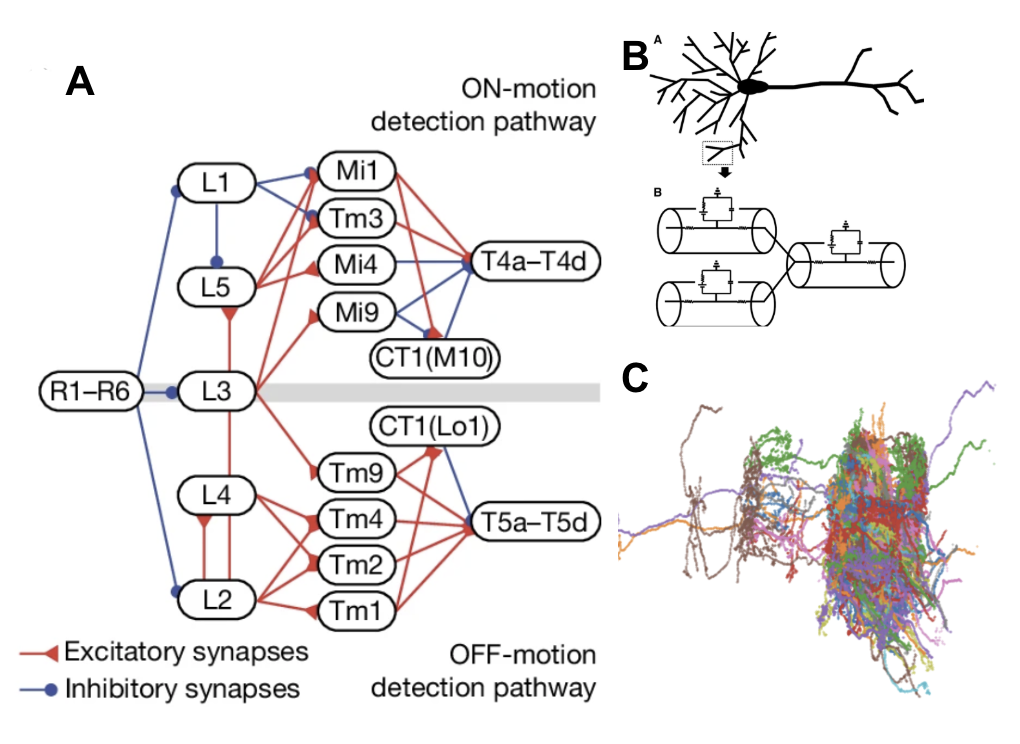
Overview
In this project, we developed multi-compartment Hodgkin–Huxley model to simulate the full motion detection circuit from photoreceptors to T4/T5 neurons. This model incorporated biologically detailed neuron morphology and neurotransmitter–receptor specificity to constrain and optimize model parameters.
Background
The motion detection pathway in Drosophila is a well-studied neural circuit that processes visual information. Understanding how this circuit works at a biophysically realistic level requires detailed modeling of the neurons and their connections.
Methods
We used multi-compartment Hodgkin–Huxley models to capture the detailed biophysical properties of neurons in the motion detection pathway. The model includes:
- Detailed neuron morphology from connectome data
- Neurotransmitter–receptor specificity
- Parameter optimization based on experimental data
Results
The model successfully simulates the motion detection circuit from photoreceptors to T4/T5 neurons, providing insights into how directional motion is computed in the fly visual system.